A somewhat popular idea but a somewhat precarious project
El Paso voters are drawn to the proposed Downtown Deck Plaza. They are considerably less comfortable with it as a publicly funded project.
That central tension is revealed by a new citywide poll conducted by Competitive Edge Research & Communication (CERC). Roughly three-quarters predict they would at least occasionally visit the Deck Park, and about 45% initially support building it, compared with roughly 39% who oppose it. Another 17% are unsure.

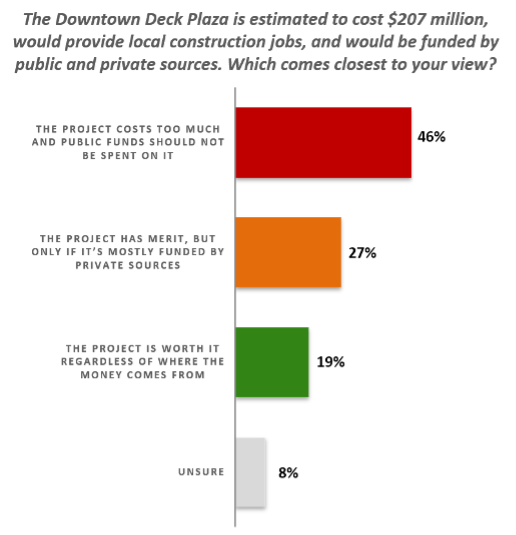
But once voters are told the project is estimated to cost $207 million, would create local construction jobs, and would draw on both public and private funding, the center of gravity shifts. Forty-six percent then feel the project costs too much and public money should not be spent on it. Another 27% would consider it only if private sources pay most of the bill. Just 19% say it is worth pursuing regardless of the cost and funding mix.
Those most likely to use it are the ones most likely to want it
Expected use of the park is the strongest predictor of support. Among voters who envision visiting weekly, 80% strongly support the plaza. Monthly visitors are also overwhelmingly favorable. At the other end, 72% of voters who say they would never visit oppose it and 86% reject the project after hearing its cost.
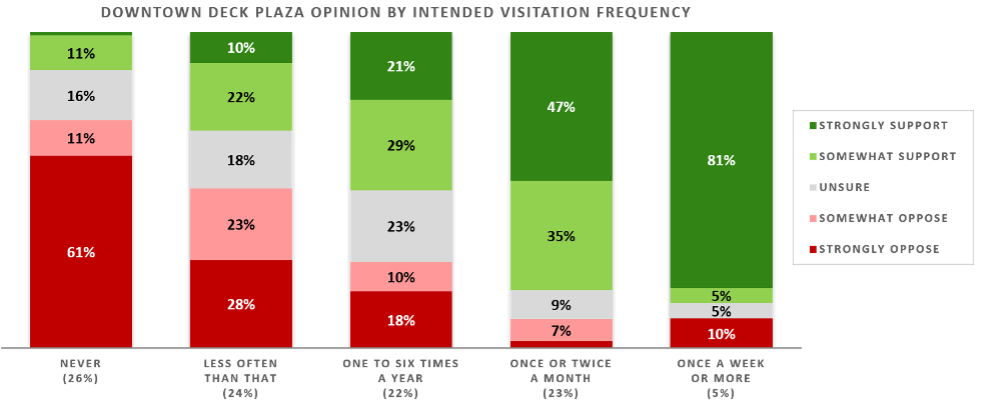
That divide produces a striking generational story. Nearly half of those younger than 44 expect to visit at least monthly, while only 13% say they would never go. Among voters 71 and older, a slim majority say they would never visit, and only 11% anticipate going frequently.
The project’s civic sweet spot is not the youngest voters, however. Nearly 60% of voters ages 35 to 55 support the plaza, including one-third who strongly support it. They may see both a family amenity and a downtown investment: a project that could attract visitors, employers, talent, and additional development. That interpretation deserves more exploration, but the data identify middle-aged El Pasoans as the plaza’s most receptive constituency.
The more voters know, the less they like it
Awareness remains shallow. Thirty-six percent have seen, read, or heard nothing about the proposal, and only 17% have encountered a great deal of information. The gaps are especially pronounced among voters surveyed in Spanish: two-thirds have heard nothing, and none have heard a great deal. Age is another factor: 68% of English-language respondents younger than 30 know nothing about the project, but that drops to 52% among 30-to-60-year-olds and to only 41% when voters are older than that.
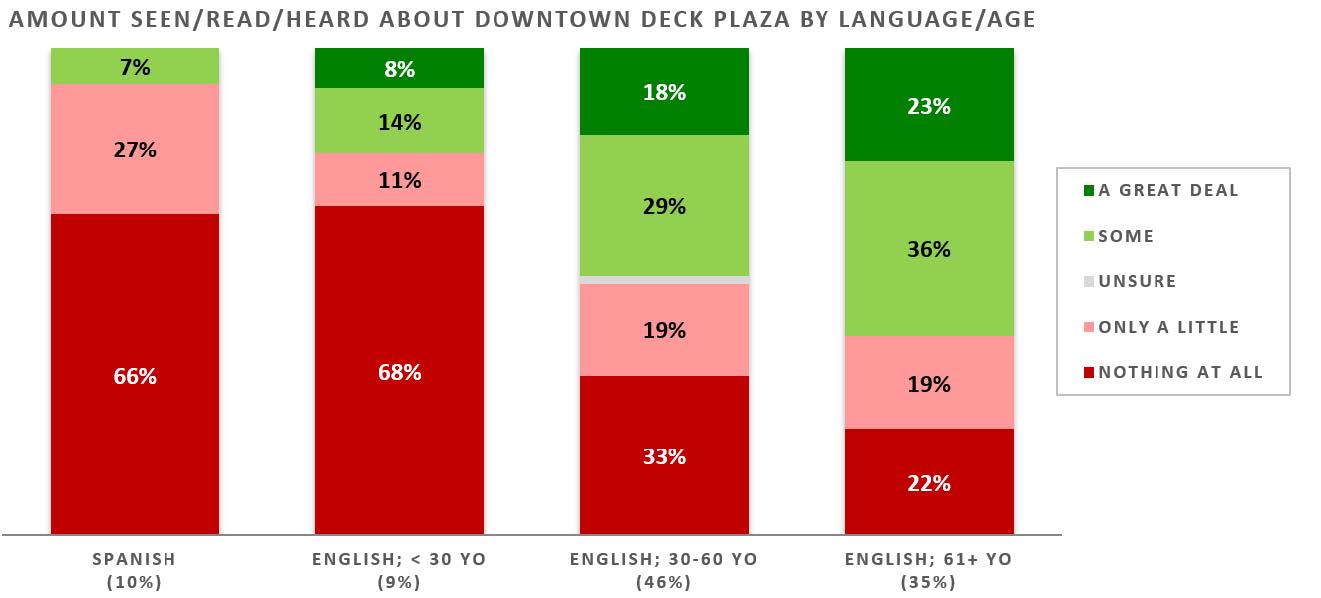
Yet greater awareness does not currently help the plaza. Support stands at 46% among voters who know nothing and 49% among those who know only a little. Opposition rises to 47% among those who have heard some information and 52% among those who have heard a great deal.
That raises an important question: Is the information reaching voters disproportionately negative, or are the people who closely follow civic affairs more skeptical of expensive downtown projects? Either way, greater exposure has so far correlated with greater resistance, not greater enthusiasm.
A geographic divide suggests the possibility of a deeper one
Support is also uneven across El Paso. In southeastern Council Districts 5, 6, and 7, 53% favor the plaza. Across the rest of the city, support falls to 40%, while 43% oppose it.
The difference may reflect neighborhood priorities. It may also point toward a broader eastside-westside disagreement over who benefits from major civic investments. The poll suggests the Deck Plaza debate is already a proxy for a larger argument about equity and downtown’s place in El Paso’s future.
The political downside is more potent than the upside
For half the voters, a council member’s position on the plaza makes zero difference. Among the rest, however, the political effect is negative: 33% would be less likely to support a council representative who backs the project, compared to 18% who would be more likely.

The risk is greatest among the 46% who oppose using public money. Most say a council member’s support would make them less inclined to vote for that representative, and 52% say it would make them much less inclined. Among public-funding opponents age 56 and older, 71% report a negative reaction, including 62% who say they would be much less likely to support the council member.
That does not make the Deck Plaza electorally fatal. The survey shows opinions remain unsettled, awareness is limited, and a lot rides on the final funding package. How elected officials frame their positions may be vote determinative. Today, however, opposition carries more political intensity. The plaza may be an attractive civic vision; as presently understood, it is not yet a safe political bet.
Methodology
Competitive Edge Research & Communication (CERC) has served the nation’s public opinion research needs since 1987, bringing multimodal survey research experience to public agencies navigating high-stakes infrastructure decisions. As a firm that adheres to the American Association of Public Opinion Research Code of Professional Ethics and Practices, CERC independently designed and administered this El Paso Freeway Deck Plaza Poll of 405 randomly selected active El Paso voters from its El Paso facility from July 21st through the 25th, 2026. The sample was drawn using scientifically valid methods to ensure representativeness across demographic and geographic subgroups, including Spanish-language respondents. Data collection was conducted by professional interviewers and weighting procedures calibrated gender, age, ethnicity (Latino), and language. The margin of sampling error associated with a survey of this type is ±4.9% at the 95% confidence level. Findings were tested for statistical significance.